
Preparing for a Brutal Winter Weekend
I knew from the moment I woke up that Saturday was going to be rough. Snow was forecast, the wind was already howling, and Winterton‑on‑Sea isn’t exactly known for its gentle microclimate. Still, Winterfest waits for no one.
The day before, I prepped everything:
- admin sorted
- batteries charged
- radio packed into the day sack
- a second bag loaded with warm kit, food, and — most importantly — a shelter to escape the elements
At 0800hrs, I set off for the coastline to activate four historic sites:
- B/G‑0581 – ROC Post Winterton Ness
- B/G‑2099 – Winterton (Former) Naval Gun Battery
- B/G‑1364 – BT Repeater Station
- B/G‑2065 – Winterton (Former) Chain Home Radar Bunker
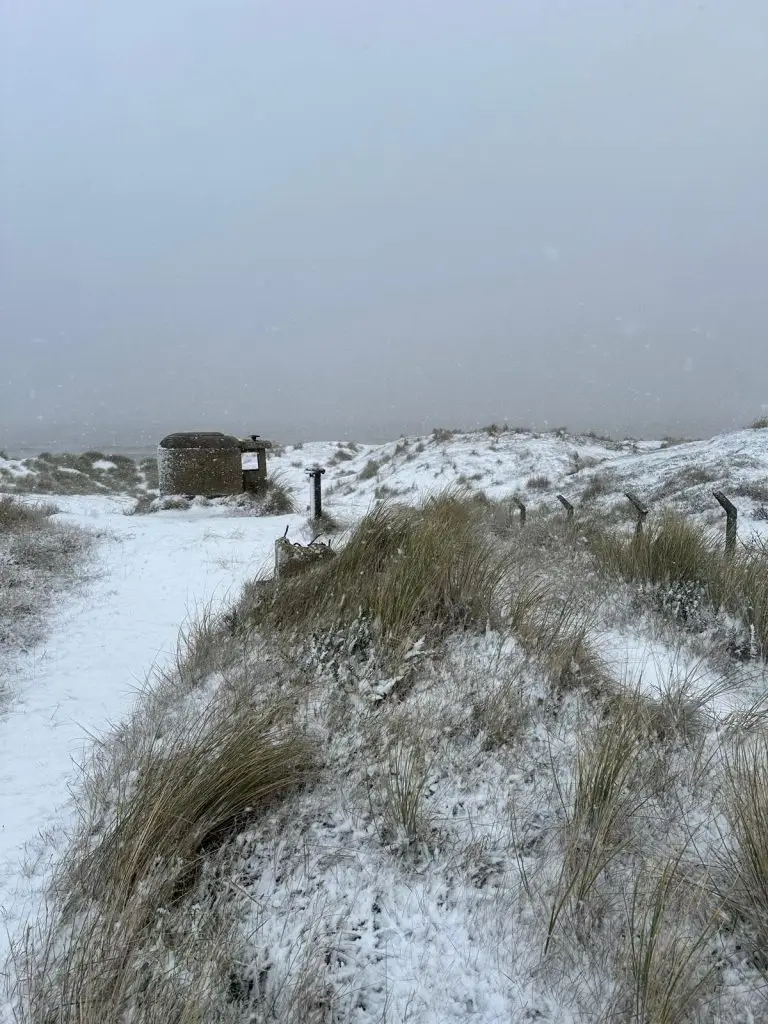
I arrived around 0830hrs to a scene that can only be described as hostile. The wind was cutting, the temperature biting, and snow was already sweeping across the dunes.
Shelter First, Radio Second
My first priority was simple: survive long enough to operate.
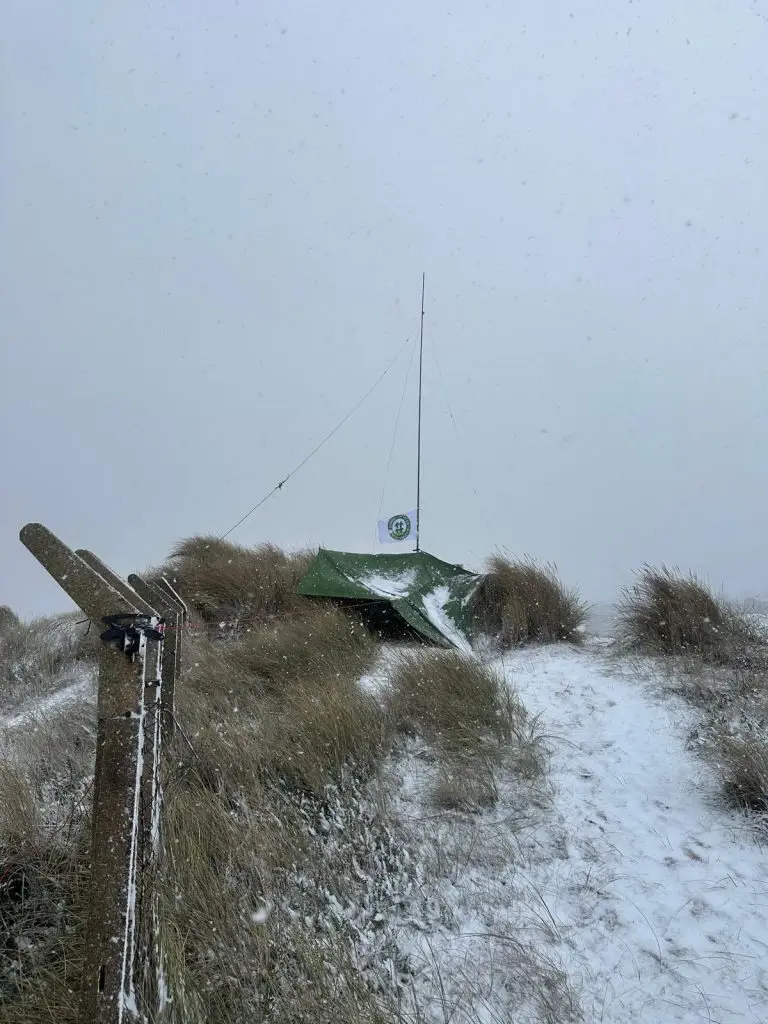
Using the remains of the old ROC Observation Post, I wrestled a tarp into place to create a makeshift shelter. The wind and driving snow made it a challenge, but eventually it held. After ten minutes warming up and waiting for the worst of the snow to ease, it was time to get the antenna in the air.
For Winterfest I used my homebrew dipole, hoisted on the DX Commander Tactical mast to around 8 metres. The broadside was oriented east–west, ideal for the day’s expected propagation.
A quick scout around revealed my second operator sensibly tucked under a small tree, doing their best to avoid the weather. Sensible choice.
Activation 1 – B/G‑0581 ROC Post Winterton Ness
Start: 1001hrs
Band: 40m
Results:
- 42 QSOs in 29 minutes
- 5 bunker‑to‑bunker contacts
- 6 DXCC entities
 ROC Post Winterton Ness
The Royal Observer Corps underground monitoring post at Winterton was part of the UK’s nuclear reporting network. These posts were designed to:
- measure blast pressure
- detect radiation
- report nuclear strike data to regional headquarters
Although now disused, the surface features and compound outline remain visible on the dunes.
A strong start to the day, despite the conditions.
Activation 2 – B/G‑2099 Winterton Naval Gun Battery
Start: 1050hrs
Band: 40m
Results:
- 34 QSOs in 24 minutes
- 5 bunker‑to‑bunker
- 9 DXCC entities
 Winterton Naval Gun Battery
The former naval gun battery at Winterton was part of the coastal artillery network defending Great Yarmouth. It housed heavy guns, observation posts, and support buildings, forming a key part of the WW2 coastal defence line.
The snow eased slightly, but the wind remained relentless.
Activation 3 – B/G‑1364 BT Repeater Station
Start: 1124hrs
Band: 40m
Results:
- 45 QSOs in 21 minutes
- 6 bunker‑to‑bunker
- 8 DXCC entities
Cold War: The Winterton BT Repeater Station
Just inland from the dunes stands a two‑storey Cold War communications bunker, often referred to locally as the BT repeater station. While detailed public documentation is scarce, its construction and internal layout strongly resemble the RAF “Uniter” hardened communications bunkers used across the UK during the 1980s.
Key features
Operators and explorers report that the Winterton site includes:
- heavy blast doors
- air filtration and overpressure systems
- two levels of reinforced rooms
- secure cable entry points
- emergency power systems
These features are consistent with hardened telecommunications nodes designed to survive nearby blasts and maintain communications during a nuclear crisis.
Strategic importance
The station’s role was to support international communications links between the UK and northern Europe, forming part of the wider Cold War civil and military communications backbone.
While not widely documented, its architecture and purpose align with the network of hardened BT and RAF communications sites built to ensure continuity of government and international connectivity during the Cold War.
This was the busiest activation of the day — the band was lively, and conditions briefly improved.
Activation 4 – B/G‑2065 Winterton Chain Home Radar Bunker
Start: 1207hrs
Band: 40m
Results:
- 41 QSOs in 18 minutes
- 6 DXCC entities
- 6 bunker‑to‑bunker contacts
 Winterton Chain Home Radar Bunker (CHL/CHEL)
WW2: Winterton Chain Home Low (CHL) Radar Station
Winterton was home to a Coastal Defence / Chain Home Low (CD/CHL) radar station, designated M135, later upgraded to K135 as a Chain Home Extra Low (CHEL) site.
What the station did
CHL radar filled a critical gap in Britain’s early‑warning network by detecting low‑flying aircraft — something the original Chain Home stations struggled with. CHL could reliably detect aircraft flying as low as 500 feet, using a 200 MHz system with smaller, rotating antennas.
Winterton’s upgrades
According to Historic England:
- The site opened in 1941 as a CD/CHL station
- In 1942, it was upgraded with centimetric radar to become a CHEL K‑series station
- It also served as an “Oboe” navigation aid site for bomber operations over Europe
A military camp stood roughly 150 metres south of the radar station to house personnel.
Although little remains visible today, the site played a key role in Britain’s coastal defence and bomber navigation network.
A fitting end to a cold but rewarding Winterfest outing.